

Stratocumulus
"low-level, lumpy, grey-white clouds formed in layers by convective instability" —NOAA

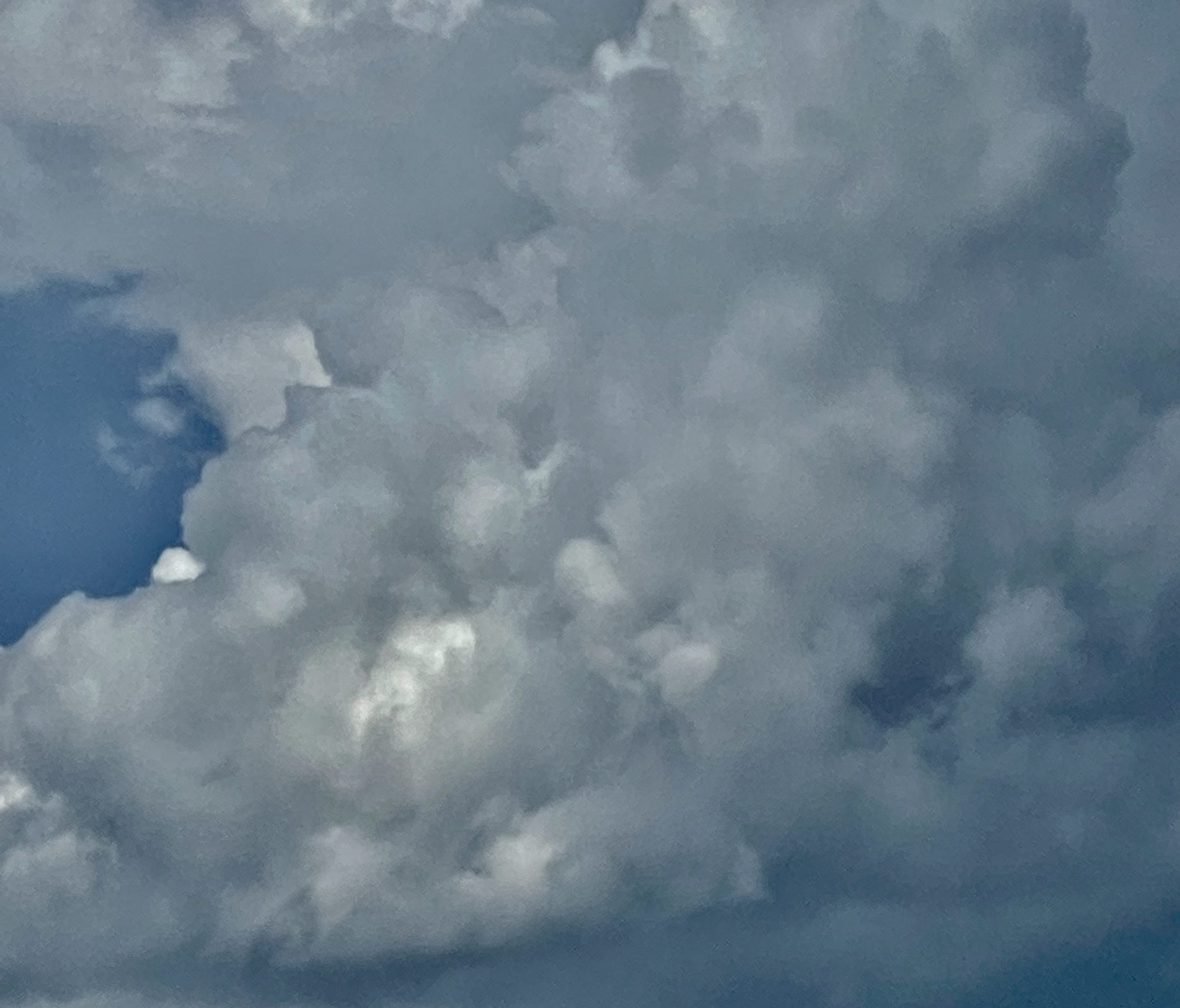
Thanks to the bit of lamina narrowing my spine, I find myself looking up at the sky more often. Gardening, I bend over to pull the crabgrass and dandelions out of the clay, and then I must stand up, arch my back, push my hips forward, look up at the sky. That’s how pain is relieved. I do this every ten minutes or so. I am making space for my spine. Or my spine is making space for me to ponder clouds.
Dozens of cloud species and variations exist across the planet. The clouds I love most, my Ohio clouds, are mostly stratocumulus. We also have the harmless, puffy cumulus on cool fall days. And in springtime, the ominous, towering cumulonimbus. Of course, we have cirrus, those thready clouds, in our skies, but my response to them is “pfft.”
I was a girl raised on drama. That includes my clouds. The dark underbellies, blue-gray like a Union soldier’s uniform, gather. They shape the sky, give it depth, dimension, personality. Clustering like gang members called out to the street, filing out of their houses to join up together, drawn like magnets. Dramatic, dangerous, dark. They appeal to my own dark side, the part of me that would like to be a badass. Unedited, brave. Brazen and unexpected.
When thunderstorms brewed outside our childhood home on Lambourne Avenue, my father’s first instinct was to grab the one intact lawn chair. Its webbing was frayed. He placed it at the edge of the garage. I stood beside him, watching the raindrops ahead of the storm front, listening to his play-by-play coverage: “There, see that? That’s the squall line,” he said, pointing to the line of white clouds stretching across the horizon at the bottom of our street when we could still see above the trees. “Behind the squall line, those are the storm clouds.”
Weather was his jam. It was more visceral, I think, than his hobbies of flying airplanes or coaching lacrosse. If stormy weather was approaching, he brought out the AM/FM transistor radio and listened for watches and warnings, giving weather the respect it deserved. While he heard the announcer’s scratchy voice in the static, my dad paid closest attention to the squall moving toward our suburban street, demarking cold and warm fronts. Barometric pressure is the weight of air. He probably pictured isobars in his imagination. None of this meant anything to me. Meteorology at six or seven years old was another secret language my father possessed, like airspeed and altitude and things that kept planes aloft.
But I did inherit my father’s infatuation for stormy weather. One of my favorite Adrienne Rich’s poems, “Storm Warning”:
…Time in the hand is not control of time,
Nor shattered fragments of an instrument
A proof against the wind; the wind will rise,
We can only close the shutters.
I draw the curtains as the sky goes black
And set a match to candles sheathed in glass
Against the keyhole draught, the insistent whine
Of weather through the unsealed aperture.
This is our sole defense against the season;
These are the things we have learned to do
Who live in troubled regions.
“We can only close the shutters.” These clouds are stuffed with metaphor.
So now, when I find myself looking up, arching my back and shifting my hips and thighs to relieve the pain in my back, I see wordy clouds and remind myself of my love affair with Ohio. Ours is a mostly innocuous landscape, hints of dangerous weather that (thankfully) rarely materialize, save for a 100-year flood or Arctic blizzard, and maybe a ropey tornado. I watch the stratocumulus clouds; they are meaty, meaningful, marching to the East.
(I wonder how long I have been focused on the ground? Preoccupied with putting one step before the other? All this time the clouds gathered, drifted on with their bold bellies, well fed and exposed. It is good to see them again.)
When my dad died and I drove the freeway north to a hiking trail to do some thinking, I looked up at the sky out of the windshield and spied a plane flying against a pristine blue sky. I knew it couldn’t have been him. He would have preferred the turbulence of riding a cumulus cloud into heaven.
On Pigspittle Pond
The pond is draining at the moment. This spring, I intend to fix the many mistakes I made in creating it—namely, using a sealant to keep the pond from draining every other day and maybe a liner to make double-sure it doesn’t drain easily. The cattails are still growing, but I would love more plants and wildlife.
In the interim, I give you this spring-timed and cloud-related poem I wrote a few years ago in a workshop group. Thanks for reading. You all give me a sense of purpose.
I dream of tornadoes
On the flat seamless horizon
Dark clouds build up and against themselves
Like crowds waiting to be let into heaven
I am in that crowd
I am that cloud
And I swirl.
Rotation is the danger sign

I know this from weather
In our once-prairie land
Before the acres of corn and soybean
Before the miles of highway
Before the suburban tracts
The prairie was here
I am a shaft of grass

In the path
Swirling cloud and grass churned
The rotation in the sky is like
A film reel running backwards
Spooling back into itself
When I am troubled
I dream of tornadoes

Barreling into the land
With the scream of a train
Don’t be too clever
Don’t look for the southeast corner
Or the basement
Or bathtub
Go with it, the tumble of grass

The weathermen talk of hooks
and tornadic vortex signature
The unwhirling of air against itself
So sit in the sweep of prairie
In the weather
Warm front clashing against cold front,
Cold front crashing against the grass.
This speaks to this Ohioan’s soul. Beautiful.
Meg: You know I can't resist poetry. I get lost in it, absorbed in it, and I just have to wait until the storm is over, however long it takes, until I have to go back to realism. Thank you for these poems, which comprise both realism and the poetic.